Search results for: “index.html”

  • No-Tell Motels

    No-Tell Motels

    No-Tell Motels
    In the Zone: I read Mike Seely’s “Inn & Out” [July 30] with great interest. Prostitution and drug use are very common in the Grand-Broadway-Bulwer-John blocks in north St. Louis. There is no question that the Mansion Motel is a haven. This has been documented by the Fifth District, where Captain Richardson has been very active. The problem is that when the police arrest the prostitutes, generally for failure to appear on outstanding warrants, they are released the next day.

    Please do not publish my name; I work in the area.

    Name withheld by request

    Soulard

    Hearts and minds be damned: It never fails to surprise me when the RFT runs yet another article pointing out the sticky and unpleasant underside of the city that we all live in. In fact, the only time I ever see something positive in the Riverfront Times is when you run your “Best Of” issue featuring restaurants, bands, clubs, tattoo parlors, etc. My assumption, from reading the RFT, is that the commerce of St. Louis is doing fine (as is the RFT‘s ad revenue), while the hearts and minds of our city are damned.

    In the two-plus years that I have lived here, I have seen a rebirth in the city, with the revitalization of downtown, the expansion of the Metro, hundreds of festivals and thousands of programs that serve the minds and the souls of our citizens. Come on, RFT: We can’t possibly be populated only with crack whores, criminal police and politicians and an alcohol-fueled community.

    We live in a world where having a Pollyanna view is practically impossible, and you should never ignore bad government or civic problems, but surely at least part of the solution should be recognizing the positive and promoting it. Using shock and titillation to get people to pick up your publication on a weekly basis is probably great for your ad sales, but it turns our community into a Jerry Springer audience and pushes us all further away from a community sorely in need of pride.

    Jim Dunn, publisher

    Playback St. Louis

    Much More Muny
    Humble, shmumble: Regarding Stellie Siteman’s letter in last week’s issue: The Muny did not have “humble beginnings” in 1919, but rather a blockbuster/stunning/world-recognized launching in June of 1917 with six performances of Verdi’s Aida, produced by Guy Golterman for the thirteenth annual Advertising Clubs of the World Convention.

    50,000-plus packed the theater, which was built in under 50 days by Parks Commissioner Nelson Cunliff and his crews to accommodate the massive production, give the World Ad Clubs’ convention its centerpiece and St. Louis the first and finest municipally owned theater in America. Rain disrupted two performances and a performance was added Sunday night. The total endeavor — theater construction and the massive performances of Aida — was delivered with a $400 surplus.

    From Paris: “All of Europe has heard of your great St. Louis triumph” — Mary Garden, opera star and founder of the Chicago Opera Company.

    The Muny, which should be alive twelve to thirteen weeks a year, has been “humbled” and cut down by a visionless board and by the pressure from the Fox Theatre, which wants to be the only game in town. Are we past the point when St. Louis can do and think big? Can’t afford to be.

    Ed Golterman

    St. Louis

    Bowled Over
    Send us your memories: The Lampson family wants to thank every firefighter and policeman who helped put out the fire at Arcade Lanes [“Last Strike,” July 23]. We are all grateful to you for risking your lives to stop the fire and appreciate your support through this life-altering experience.

    We want to thank each customer that came through our doors at Arcade Lanes. We have been at Arcade Lanes since the late 1950s. All our customers will be missed, and we want them to know we appreciate their years of patronage.

    Arcade Lanes is now gone, and so is the memorabilia. These items were displayed for our customers to enjoy and see how our ancestors lived. All who visited Arcade Lanes knew Dad (Jim) would share a story and his memorabilia to enlighten you, sometimes for hours.

    We have tried to make sense of such a tragedy and we struggle with the loss of the items we held dear. We have enjoyed our customers through the years and hope they could find it in their busy schedule to send a story or a picture of time shared at Arcade. We want to put a scrapbook together for our family. Thank you for the memories, and please include a return address. Please send to:

    Jim Lampson

    Arcade Lanes

    7579 Olive Boulevard

    University City, MO 63130

    We want to thank Bruce Rushton for his articles about Dad. We hope he knows the joy he brought to Dad by his visits. We’re glad Bruce was there the day of the fire, because Dad would have tried to put the fire out and not called 911 in time.

    The Lampsons

    University City

  • Last-Minute Ideas to Celebrate Mother’s Day in St. Louis

    Last-Minute Ideas to Celebrate Mother’s Day in St. Louis


    click to enlarge

    The food from Hatch'd one of those wonderful spots that doesn't take reservations and remains a brunch option this Mother's Day.

    Mabel Suen

    The food from Hatch’d one of those wonderful spots that doesn’t take reservations and remains a brunch option this Mother’s Day.

    So, you waited till the last minute to make a plan to celebrate mom. That’s OK. You can still pull off something nice with the following events and ideas.

    Brunch
    We’re not going to sugar coat it, getting a brunch reservation this late in the game is going to be difficult. (Bowood was booked up back in March.) But never fear! There are places you can go where you can’t make a reservation beforehand. (Work smarter not harder.) You can join an online waitlist or stop by and take your chances on Sunday.

    Olive + Oak
    216 West Lockwood Avenue, Webster Groves; 314-736-1370
    The Women’s Creative is hosting a Mother’s Day brunch at Olive + Oak, and while reservations are required, there still seem to be some available. The buffet will include a mimosa bar, coffee, and a Procure Market from noon to 4 p.m. in Olive + Oak’s atrium hall. Tickets are $45. Check out the website for more details.

    Hatch’d STL
    6931 Gravois Avenue, 314-448-1642
    Located in Princeton Heights, Hatch’d has one of the best new brunches around with skillets, waffles, egg dishes, parfaits, and more. Not only is everything delicious, but they don’t take reservations. Instead, you can join the online waitlist and act like you had a plan in place for mom this whole time.

    The Fountain on Locust
    3037 Locust Street, 314-535-7800
    This brunch will be banging with mimosa flights, ice cream and waffles and a free World’s Smallest Ice Cream Cone to every mother. The restaurant encourages guests to sign up for the waitlist ahead of their arrival, since it only takes reservations on weekdays. The Fountain is open 11 a.m. to 9 p.m. on Sunday, May 14.

    The Shack
    Multiple locations including 12521 Olive Boulevard, Creve Coeur; 314-548-2150
    The Shack not only has great food, top notch cocktails, and fast service, but it also doesn’t take reservations, which means even if you had known months ago you wanted to take mom here, you could not have done anything about it. But you can avoid waiting with mom for three hours in the restaurant (hey, writing on the walls is only fun for so long.) Visit eatshack.com/waitlist to join the waitlist day of. Don’t wait until you want to go to check the waitlist, check it out an hour or two before hand.

    Rooster
    Multiple locations including 1025 Washington Street, 314-241-8118
    One of the best brunches is St. Louis is available to you without reservation on Mother’s Day. You can head downtown or to South Grand Boulevard for Bloody Marys and mimosas, local coffee, and some delicious food.

    City Coffeehouse & Creperie
    36 North Brentwood Boulevard, Clayton; 314-862-2489
    Those beautiful, thin French pancakes have gotten a glow up at City Coffeehouse, where you can get the crepes savory or sweet. They come stuffed with things like French brie and walnuts, garnished with red grapes and strawberry (the Provence), or you can grab a Shaw Park that’s got turkey, spinach, Havarti Cheese & roasted red peppers. If you’re not a fan of crepes there are Belgian waffles, bagels and other breakfast items. If you’re grabbing an early brunch, this place is ideal. It closes at 2 p.m. and all orders placed after 1:30 are to-go. But it opens at 7 a.m. and is first come-first served.

    Yolklore
    8958 Watson Road, Crestwood; 314-270-8538
    The dining area here is small, so it may be too crowded when you arrive at 11 a.m., but never fear, there’s a drive-thru as well. The great thing about Yolklore is the attention to detail. The ice cubes in the iced tea are also made of iced tea, for instance, so you can drink to the last drop. The food is healthy, but still tastes great and they offer familiar classics like pancakes, biscuits and gravy, and bacon and eggs, while also dishing up flavorful frittatas. There’s no booze, but mom won’t mind after she tastes a mixed berry smoothie.

    Original Pancake House
    Multiple locations including 8817 Ladue Road, Ladue; 314-932-1340
    The pancakes here do not disappoint and while there is no booze, the food is good enough that everyone will leave happy. Though it’s a national chain, you can still get some good ambiance at the restaurant and it’s pretty big. There’s also a way to join the waitlist online so you don’t have to wait in the restaurant for hours, and the Ladue location is in a little shopping area so you can entertain yourself at the boutiques nearby while you wait.

    Beyond Brunch
    Hey, not all moms want to get tipsy on Mother’s Day or eat a ton of carbs. Here are a couple other options.

    Eckert’s Strawberry Festival
    951 South Green Mountain Road, Belleville, Illinois
    Eckert’s will be giving out free strawberry sundaes from Friday, May 12, through Mother’s Day on Sunday, May 14, to any moms that stop by Mr. E’s Donuts and Custard Shop. There is also a Strawberry Festival going on that includes carnival rides, a petting zoo, wagon rides, strawberry picking and more. Admission is free but some of the activities cost extra. The event runs 10 a.m. to 5 p.m.

    Spend the morning with mom hitting the pavement on Sunday, May 14, at the Chesterfield Mother’s Day 5K Run/Walk. The run will start at The District, and you can access parking at 17057 North Outer 40 Road in Chesterfield. The 5K is $39.99 for adults, $9.99 for kids 11 and under. Each finisher gets a rose and a cake pop. Visit the website for more information.

    Coming soon: Riverfront Times Daily newsletter. We’ll send you a handful of interesting St. Louis stories every morning. Subscribe now to not miss a thing.

    Follow us: Google News | NewsBreak | Reddit | Instagram | Facebook | Twitter

  • 10 Events to Celebrate MLK Day in 2024 St. Louis

    10 Events to Celebrate MLK Day in 2024 St. Louis

    The Reverend Martin Luther King, Jr. helped change the world with his iconic “I Have a Dream” speech, delivered during the March on Washington in 1963. And as one of the most notable leaders of the U.S. civil rights movement, the Baptist minister and activist played a key role in the movement for civil and economic equality for African Americans from the mid-1950s until his assassination in 1968.

    Each year, on the third Monday of January, we remember his legacy nationwide.

    This Monday, January 13, and the weekend following up to it, celebrate King with one of the following St. Louis MLK Day commemorations:

    Centennial Christian Church of St. Louis
    Kick off your MLK Day celebration Saturday, January 13, with a Unity Gathering in Fountain Park (located across from the church at 4950 Fountain Avenue) with the Centennial Christian Church starting at 9:30 a.m., which will then be followed by a teach-in event at the church. The family-friendly event promises a day of learning skills that can positively strengthen the collective voice and impact neighborhoods and communities in St. Louis, as well as fun, food and fellowship. To register, visit Centennial Christian Church on Facebook.

    2024 Rev. Dr. Martin Luther King Jr. Celebration: Boldly Embracing a Legacy of Greatness
    On Sunday, January 14, the free, annual Rev. Dr. Martin Luther King, Jr. celebration will be held at the Farrell Auditorium (One Fine Arts Drive) from 2 to 3:30 p.m. The celebration will highlight the richness of the Black experience in America with original theatrical work created and performed by Kathryn Bentley, Geovonday Jones and Jacqueline Thompson. The program will also include speaker Rebeccah Bennett, founder and principal of Emerging Wisdom and a call to action from Marcus A. Creighton, on behalf of the Alpha Phi Alpha Fraternity Inc., Epsilon Lambda Chapter.

    Missouri History Museum MLK Community Celebration
    Celebrate the life and legacy of Dr. Martin Luther King Jr. throughout the holiday weekend at the Missouri History Museum (5700 Lindell Boulevard) with their MLK Community Celebration. Friday, January 12; Saturday, January 13, and Monday, January 15, from 10 a.m. to 2 p.m., take part in the Activist City: Creating Community in St. Louis to learn more about the people, places and issues that inspired activists in the past. All weekend long there will be youth activism workshops, meaningful conversations on race and social justice, storytelling, movement with Mama Lisa and craft workshops. On Sunday afternoon there will be an MLK Commemoration and gospel concert followed by an after-hours, all-levels yoga class set to live gospel music with The Collective STL. For a complete schedule, visit the Missouri History Museum’s website.

    St. Louis Symphony Orchestra
    On Monday, January 15, at 7 p.m., the St. Louis Symphony Orchestra will be performing at the Manchester United Methodist Church (129 Woods Mill Road, Manchester) to celebrate the legacy of Dr. Martin Luther King, Jr. The St. Louis Symphony IN UNISON Chorus Young Artists and SLSO musicians will take the stage, led by esteemed director Kevin McBeth, for an evening filled with inspiration and thoughtful reflection.This free performance is open to the public and requires no reservations.

    Washington University’s Dr. Martin Luther King Jr. Commemoration
    Washington University will be holding their 37th annual Dr. Martin Luther King, Jr. Commemoration on Monday, January 15 from 2 p.m. to 3:30 p.m. in the Graham Chapel on campus. The free and public event will honor the legacy of Dr. King and the impact he has made on those who carry the torch for humanity. Livestream will be available for those unable to attend in person.

    Let the Dream Ring
    The Bayer YMCA (5555 Page Boulevard) is having their 39th annual commemorative breakfast and awards ceremony, in honor of the life and legacy of Dr. Martin Luther King, Jr. on Monday, January 15 from 7 a.m. to 9 a.m. To register visit their website.

    Dr. Martin Luther King, Jr. Holiday at the University of Missouri–St. Louis
    On Monday, January 15, 2024, the University of Missouri-St. Louis is having their Dr. Martin Luther King, Jr. holiday celebration in the Touhill Performing Art Center (1 Touhill Circle) at 11 a.m. This year’s theme is Economic Justice: Honoring Dr. King’s Legacy and Fight to End Economic Inequality and Poverty with keynote speaker Benjamin Jealous, former NAACP president, equality activist and executive director of the Sierra Club. For additional information, please contact the UMSL Office of Diversity, Equity and Inclusion at [email protected].

    2024 Dr. Martin Luther King Jr. Celebration
    Join the St. Louis Community College in Florissant Valley and North County Churches Uniting for Racial Harmony and Justice for their annual Dr. Martin Luther King Jr. Celebration on Tuesday, January 16 at the Florissant Valley Student Center (3400 Pershall Road, Ferguson). The event starts at 6 p.m. but guests are welcome to come at 5 p.m. to enjoy light refreshments. The livestreamed and in-person event will include inspiring speeches, celebrating excellence in the community with a formal award presentation and more. Rev. Darryl Gray, a 40-plus-year veteran of the Civil and Human Rights Movement in the United States and Canada, will be the keynote speaker at the event and will speak to this year’s theme: “Now is the Time.”

    Annual Mid-St. Louis County Martin Luther King, Jr. Weekend Celebration
    Celebrate Dr. Martin Luther King, Jr. Day all weekend with the annual Mid-St. Louis County Martin Luther King, Jr. Celebration: “Character of the Man of the Year.” The event will consist of a leadership and prayer breakfast, a community service project, a parade followed by a program and guest speakers. On Saturday, January 13, take part in the Beautification Project at 12 p.m. at 5955 Martin Luther King Drive. Sunday, January 14, there will be a MLK Unity Worship Service at 10:45 a.m. at Calvary Bible Church (825 Graham Road). Monday, January 15, the 2.2 mile parade will begin at 11 a.m. at Normandy High School (6701 St. Charles Rock Road, Wllston). Then at 12 p.m., the MLK program and guest speakers will be at Barack Obama Elementary School (Jennings Station Road, Pine Lawn). RSVP your attendance and participation on the Young Voices’ website.

    Lincoln Memorial Rally
    On Sunday, January 14, the Missouri Progressive Missionary Baptist State Convention and the St. Louis Progressive Missionary Baptist District Association will hold a collective of faith, civil rights and labor leaders to recreate the historic Lincoln Memorial Rally of 1963 at the Christ Pilgrim Rest Missionary Baptist Church (1341 Kingshighway Boulevard). Participating in the program will be representatives of the following organizations: Missouri AFLCIO, Urban League, NAACP St. Louis City and County, A. Philip Randolph Institute, National Black Catholic Congress, Catholic Diocese of St. Louis, Young Voices with Action, St. Louis Metropolitan Clergy Coalition, American Federation for Government Employees, Jewish Community Relations Council of St. Louis and others.

    Subscribe to Riverfront Times newsletters.

    Follow us: Apple NewsGoogle News | NewsBreak | Reddit | Instagram | Facebook | Twitter | Or sign up for our RSS Feed

  • 30 St. Louis New Year’s Eve Parties to Ring in 2024

    30 St. Louis New Year’s Eve Parties to Ring in 2024

    New Year’s Eve is right around the corner, and you know what that means — dinner, parties, bling and Champagne. (Let’s be honest, we’re all here to pop some bottles.)

    St. Louis is ready to ring in 2024, whether that’s with a midnight toasting at Ballpark Village, fireworks at Winterfest with the kids or the Fountain on Locust’s Early Bird Flights of Fancy for those of us who don’t want to stay out all night. Check out these 30 St. Louis celebrations to ring in the new year St. Louis style.

    Scroll down to view images
    Page 1 of 2
    New Year's Eve, Ballpark Village

    Courtesy of Ballpark Village

    NYE Live! at Ballpark Village

    Ring in 2024 at NYE Live! at Ballpark Village (601 Clark Avenue). Party-goers can look forward to a premium all-inclusive drink package from 8 p.m. to midnight with access to seven venues, VIP experiences, NYE-themed party favors, a Champagne midnight toast, DJ performances, confetti, a midnight celebration and the only ball drop in St. Louis. Tickets start at $95 for the silver level, $130 for gold level and $160 for platinum level.

    1 of 30
    Cherub

    Collin Taylor // @LiveEditsLab

    NYE with Cherub at The Hawthorn

    Inspired by ‘80s post-disco, synth-pop and funk, Nashville-based duo Cherub consists of Jason Huber and Jordan Kelley. The irreverent, fun-loving pair will help you send off 2023 at the Hawthorn (2231 Washington Avenue) in Downtown West. Get your tickets today on the Hawthorn’s website.

    2 of 30
    24K Gold New Year’s Eve Party at Live! By Loews Live! By Loews (799 Clark Avenue) is throwing a 24K gold soirée for New Year’s Eve. At the downtown hotel, guests can enjoy live music from JAM: Jackson and Mars, an open bar and hearty hors d’oeuvres — think Alaskan snow crab, lobster mac ‘n’ cheese, blackened scallops, beef tenderloin satay, General Tso’s steamed buns, black bean empanadas, an assortment of sushi and a display of international cheeses.

    COURTESY PHOTO

    24K Gold New Year’s Eve Party at Live! By Loews

    Live! By Loews (799 Clark Avenue) is throwing a 24K gold soirée for New Year’s Eve. At the downtown hotel, guests can enjoy live music from JAM: Jackson and Mars, an open bar and hearty hors d’oeuvres — think Alaskan snow crab, lobster mac ‘n’ cheese, blackened scallops, beef tenderloin satay, General Tso’s steamed buns, black bean empanadas, an assortment of sushi and a display of international cheeses.

    3 of 30
    Molly's, New Year's Eve

    COURTESY PHOTO

    NYE 2024 at Molly’s in Soulard

    Molly’s in Soulard (816 Geyer Avenue) knows how to party, and for the 18th year in a row, the neighborhood bar will host its New Year’s Eve extravaganza. Tickets ($70+) include access to five open bars serving beer, wine and cocktails, three DJs, two balloon drops and one Champagne toast. Molly’s in Soulard also boasts the largest patio in St. Louis, which will be covered by heated tents for the night. Want to splurge? Check out the VIP tables ($500) and cabanas ($1,250).

    4 of 30
    Ritz-Carlton, New Year's Eve

    COURTESY PHOTO

    New Year’s Eve Live Music and Champagne Bar

    Toast in the new year in the lobby lounge of Clayton’s Ritz-Carlton (100 Carondelet Plaza) by celebrating with live music performed by Arvell & Co., three satellite bars, a Champagne bar and party favors. The event and standing room are complimentary with access to a la carte food and beverage offerings. Guests may reserve VIP seating with a $500 minimum spend per table. To reserve VIP seating, call (314) 719-1450 or email [email protected].

    5 of 30
    Riverboat cruises at the Gateway Arch.

    New Year’s Eve Dinner Cruise on the Riverboats at the Gateway Arch

    For New Year’s Eve, the Riverboats at the Gateway Arch (50 South Leonor K Sullivan Boulevard) will remix their popular dinner cruise. Enjoy a live DJ and a plated dinner featuring grilled chicken, broiled shrimp, steak, twice-baked potatoes, garlicky green beans, house salad and cheesecake. Guests can also ring in the new year early with a Champagne toast for adults and sparkling cider for kids. Cruise reservations are required. TIckets are $110 for adults and $25 for children 12 and under.

    6 of 30
    New Year Eve, Riverboats at the Gateway Arch

    Courtesy of Riverboats at the Gateway Arch

    New Year’s Eve Party Cruise on the Riverboats at the Gateway Arch

    The Riverboats at the Gateway Arch (50 South Leonor K Sullivan Boulevard) are also hosting a New Year’s Eve party cruise. Dress your best and enjoy complimentary domestic beer and house wine, hors d’oeuvres, dessert, a live DJ and dancing. At midnight, guests will also toast with champagne. This 21-year- and-older cruise is $110 per ticket, and boards 30 minutes prior to departure.

    7 of 30
    Bistro, New Year's Eve

    Courtesy photo

    New Year’s Eve Dinner at the Bistro

    Enjoy a French, five-course New Year’s dinner at Bistro La Floraison (7637 Wydown Boulevard) in Clayton. Tickets ($125) include all the food served that evening but drinks will be available for purchase off the full bar and wine list.

    8 of 30
    Winterfest, New Year's Eve

    Courtesy of Gateway Arch Park Foundation

    Neon Nights at Winterfest

    Looking for something a little more family friendly? In downtown St. Louis, Kiener Plaza (500 Chestnut Street) goes into overdrive for the holidays. Hosting Gateway Arch Park Foundation’s Winterfest, the park fills up with fan favorites such as ice skating, s’more stations and igloos positioned under 100,000 twinkling lights. Neon Nights, a family-friendly New Year’s Eve celebration, will mark the end of the festivities. Expect a DJ, fire dancers, princesses, superheroes, party favors, photo experiences and a fireworks display.

    9 of 30
    Mabel Suen

    New Year’s Eve Dinner at Casa Don Alfonso

    Ring in the new year with Casa Don Alfonso’s (100 Carondelet Plaza) five-course, prix fixe menu, with the esteemed culinary team at this Clayton restaurant carefully crafting every dish. Highlights include cannoli stuffed with winter vegetables, stir-fried lobster with burrata foam and black truffle, and shrimp and ricotta ravioli with tomato jus. The third course truly sings with your choice of turbot paired with artichoke flakes, potato mille-feuille, mint and white wine cream; osso buco served with gremolata and saffron velouté; roasted duck breast on a bed of pear purée, red berries, candied chestnuts and spinach; or cabbage dumplings plated with polenta and a red wine reduction. Reservations are available at 5 and 8 p.m.

    10 of 30
    New Year’s Eve Featuring Trixie Delight at Hollywood Casino & Hotel St. Louis Dance the night away at this rockin’ New Year’s Eve party hosted by Hollywood Casino & Hotel St. Louis (777 Casino Center Drive), where Trixie Delight will play songs from the best bands of the 1970s, 80s and 90s. The event will take place in the Nightclub starting at 9 p.m. Tickets are $15 for one, $25 for two.

    New Year’s Eve Featuring Trixie Delight at Hollywood Casino & Hotel St. Louis

    Dance the night away at this rockin’ New Year’s Eve party hosted by Hollywood Casino & Hotel St. Louis (777 Casino Center Drive), where Trixie Delight will play songs from the best bands of the 1970s, 80s and 90s. The event will take place in the Nightclub starting at 9 p.m. Tickets are $15 for one, $25 for two.

    11 of 30
    New Year’s Eve Celebration With The Hamiltones at City Winery End the holiday season with music, wine and food on New Year's Eve at City Winery St. Louis (3730 Foundry Way) where intimate shows, world-class wine and great food take center stage. City Winery St. Louis' year-end show is New Year's Eve With the Hamiltones, Sunday, December 31 at 7 p.m. and 11 p.m. Stage premier tickets are $75, premier tickets are $65 and reserved tickets are $55. 

    COURTESY OF THE ARTIST

    New Year’s Eve Celebration With The Hamiltones at City Winery

    End the holiday season with music, wine and food on New Year’s Eve at City Winery St. Louis (3730 Foundry Way) where intimate shows, world-class wine and great food take center stage. City Winery St. Louis’ year-end show is New Year’s Eve With the Hamiltones, Sunday, December 31 at 7 p.m. and 11 p.m. Stage premier tickets are $75, premier tickets are $65 and reserved tickets are $55. 

    12 of 30
    The well-lit bar includes seesaws.

    ROSALIND EARLY

    Blast from the Past Party at Armory STL

    Take a trip down memory lane this New Year’s Eve at the Blast From The Past NYE Party at Armory STL (3660 Market Street). The six bars on site will evoke various iconic time periods from The Roaring Twenties to Y2K. Guests can enjoy unique drinks, food, live music from Dr. Zhivegas, lights, entertainment and a Champagne toast. Tickets start at $100. 

    13 of 30
    Four Seasons Hotel, Cinder House, New Year's Eve

    Courtesy of Four Seasons Hotel St. Louis

    New Year’s Eve Fête at Cinder House

    New Year’s Eve at Cinder House (999 North 2nd Street) will be a lavish celebration with a stylish ambiance and views of the Gateway Arch. For the occasion, the restaurant will offer a luxurious three-course menu with options such as duck, lobster and filet mignon. To elevate the dining experience, there will also be a caviar service available for two for $150. Cinder House’s sommeliers will offer pairings of Champagne, sparkling wine and still wine to complete the culinary adventure. Reservations are required, and a $50/person deposit will be taken at the time of booking.

    14 of 30

  • As St. Louis’ School Desegregation Program Winds Down, No One Can Say What Comes Next

    As St. Louis’ School Desegregation Program Winds Down, No One Can Say What Comes Next

    For the past five years, Cynthia Wren, 66, has applied to get her ten-year-old granddaughter, Ariel Gibson, into St. Louis’ student desegregation program.

    The Voluntary Interdistrict Choice Corporation, or VICC, oversees the student transfer program. It is a race-based transfer that allows black city children to attend county schools, even as white students in the county can attend city magnet ones.

    Ariel is black and lives in the Shaw neighborhood of St. Louis city. Part of her application includes ranking her interest in much more highly rated suburban districts. If she’s chosen, it could be a ticket to a top-tier public school district: Brentwood, Kirkwood, Clayton.

    But she hasn’t gotten in. So the ten-year old attends Tower Grove Christian Academy. In lieu of sending her granddaughter to an elementary school run by the St. Louis Public Schools, or SLPS, Wren pays Ariel’s private school tuition. A former teacher’s assistant and current substitute for St. Louis County Special School District, Wren says that paying Ariel’s tuition is a hardship for her family.

    “It’s not always easy,” she says. “But we do what we have to do.”

    Wren plans to continue applying to VICC for her granddaughter in the years to come. But it’s a lottery situation, and with a 17 percent acceptance rate, the odds are against her.

    “I just don’t understand the situation,” Wren says. “[Ariel’s] being skipped over and it breaks my heart to know she hasn’t gotten in.”

    Ariel isn’t alone. In 1999, VICC reached its peak enrollment of 14,626 students. Since then, though, the program has been on steady decline. Last school year, 4,392 students were enrolled.

    It’s not a case of lessening demand. A total of 2,488 black students living in the city applied to VICC for the 2017-2018 school year. Just 413 were accepted. (Of the 148 white students from the county who applied to attend St. Louis magnet schools through VICC, 85 were accepted.)

    And the clock is ticking for Wren and her granddaughter. This month marks the official beginning of the end for the desegregation program, beginning the five-year extension that provides one final reprieve before the education leaders running VICC plan to shut it down entirely.

    VICC oversees the longest-running race-based student transfer program in the nation, and even as it’s brought a dose of color to many affluent county districts, it’s also been a real boon to thousands of lucky city kids. State Representative Bruce Franks (D-St. Louis), who graduated from Lindbergh High School in 2002, is just one prominent alumnus.

    Yet if you ask the people in charge of the program — the superintendents of the twelve schools that make up VICC’s governing board — what comes next, and what they’ll be doing to increase diversity in districts that would be largely monolithic absent the transfer students, they’ll acknowledge they don’t know just yet.

    “We want to roll into this new five-year extension,” says Eric Knost, Rockwood superintendent and VICC chairman for the 2017-2018 school year. “Once things start to settle a little bit, we will start talking about what’s beyond the five-year extension.”

    He acknowledges, “We really haven’t even scratched the surface yet on what’s to come.”

    Since 1981, more than 70,000 black students from St. Louis city have attended schools in St. Louis County through the VICC program. Under its auspices, white students from the county have also been attending magnet schools in the city since 1982, albeit in much smaller numbers (9,000).

    Those students have added much-needed diversity to some county districts. In 1999, the year of VICC’s peak enrollment, participating county districts notched an average of 20 percent black students. Had VICC not existed, the projected black enrollment would have averaged a mere 4 percent.

    Nearly two decades later, not much has changed, demographically. In 2017, black enrollment within participating districts averaged around 15 percent. Without VICC it would’ve been just under 7 percent.

    But as the years have gone by, some of VICC’s original participants have pulled out. Hazelwood, which was steadily growing more diverse even without transfer students, left in 1988. Ladue and Ritenour both exited in 1999, Pattonville in 2005 and Lindbergh in 2011. (Students in the program were allowed to graduate from the districts they’d been placed in, making the districts’ withdrawal a gradual one.)

    According to VICC, the districts left the program after finding other ways to enable diversity in their schools. Ladue, for example, consolidated its ten neighborhood elementary schools to four in the 1970s. At that same time, Ladue also redrew its school boundaries. In doing so, the district, which is made up of nine municipalities (Creve Coeur, Crystal Lake Park, Frontenac, Huntleigh Village, Ladue, Olivette, Richmond Heights, Town and Country and Westwood) plus some parts of unincorporated St. Louis County, created more racial diversity in its schools.

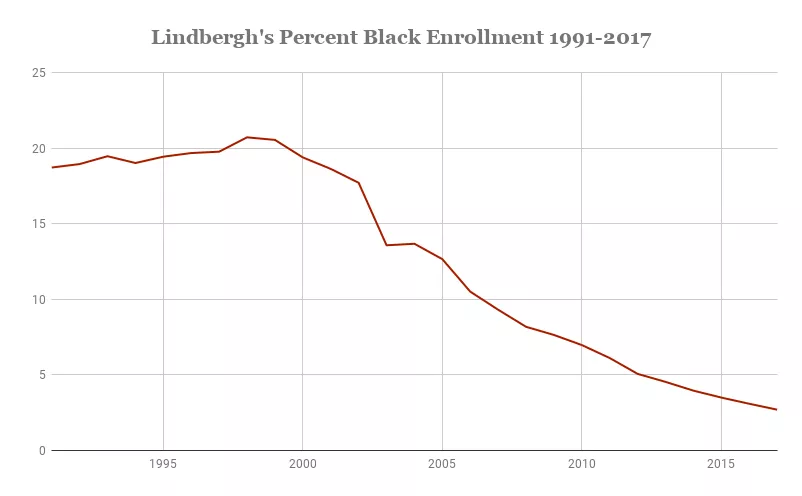
    Lindbergh, though, hasn’t quite done that. The district saw black enrollment as high as 20.56 percent in 1999 thanks to its participation in VICC. By the time it pulled out, that had dropped to 6.11 percent. Lindbergh’s last VICC student graduated in 2017, and at that point, its black enrollment had sunk to just 2.69 percent — around ten times smaller than it was in 1999.


    The percentage of black students at Lindbergh schools plummeted after it pulled out of VICC. - GRAPHIC BY CAMILLE RESPESS

    GRAPHIC BY CAMILLE RESPESS

    The percentage of black students at Lindbergh schools plummeted after it pulled out of VICC.

    In the coming years, absent some sort of replacement transfer program, what’s happening at Lindbergh could happen to districts across the county.

    VICC’s board approved that final five-year extension in November 2016. It’s set to run from the school year that just began through 2023-2024 and will accept around 1,000 students into the twelve participating school districts during these five years. Priority for acceptance into VICC during its final extension will be given to siblings of students already in the program.

    It’s a long goodbye, by any measure. If a kindergartner is chosen for the program during its last year, 2023, he or she wouldn’t be on track to graduate until 2036 — walking an increasingly lonely road as other minority students graduate and move on.

    From its inception, VICC’s model was built on continual phase-out. The program was set up in 1999 to dwindle at a rate of 5 percent over a twenty-year period. And that’s exactly the outline its remaining districts are following.

    VICC leaders say that their long-held plan to phase out the program dovetails nicely with the growing ambitions of the St. Louis Public Schools. After all, VICC takes black students to county schools who would have otherwise been zoned to attend city schools.

    “Clearly, county schools benefit [from VICC] by creating a more real and diverse student environment,” Knost says. “At the same time, we have got to keep the interest of the SLPS.”

    In 2012, the St. Louis district regained provisional accreditation after five years of operating as non accredited. In 2017, the district became fully accredited.

    “We are trying to be competitive as we can for families to look at us as a real option,” SLPS superintendent Kelvin Adams says.

    But while Adams says he believes the desegregation program has fulfilled its purpose, he agrees the ending of this iteration of VICC may not mean the end of transfer programs between the city and county school districts.

    “I’m not saying it can’t continue in some way, shape or form in the future,” Adams says.

    Maalik Shakoor, 22, graduated from Clayton High School in 2014. He was bussed from his neighborhood of Baden in north St. Louis for the twelve years he was in VICC: first to Bierbaum Elementary School in south county, then to Clayton for middle and high school.

    Shakoor graduated from Webster University in May with a degree in film production. He’s spent the summer as a teacher at the Freedom School in St. Louis.

    Though Shakoor wishes he could have gotten a strong education in his own neighborhood, he sees the value in VICC.

    “If [black children in the city] can’t get a good, quality education where they’re at, then the next best solution is to bus them out,” he says. “Until the city schools can be up to par with the county schools, I see no other option.”

  • St. Louis Philanthropist Des Lee Dies at 92

    St. Louis Philanthropist Des Lee Dies at 92

    E. Desmond “Des” Lee, a lifelong Missourian and successful entrepreneur who leveraged his business success to fund arts and education, died today at St. John’s Hospital. He was 92.


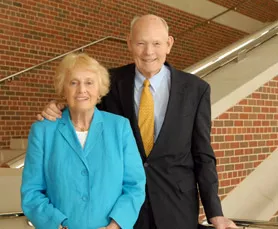
    E. Desmond "Des" Lee (1917-2010) with his wife, Mary Ann. - umsl.edu

    umsl.edu

    E. Desmond “Des” Lee (1917-2010) with his wife, Mary Ann.
    ​According to a press release from his family, Lee gave away in excess of $70 million over the years, most of it to children’s organizations. Another favored recipient: the Saint Louis Symphony Orchestra.
    Lee was born in Sikeston in 1917 and grew up in Columbia. A graduate of Washington University, he enlisted in the U.S. Army and served as a captain during World War II. After the war he formed a manufacturing company with his father and another father-son tandem. Their first business success: a metal trouser creaser and hanger marketed to department stores.
    Lee’s legacy includes the Des Lee Collaborative Vision, a foundation that endows chairs at UMSL, Wash. U. and Webster U.
    See full press release after the jump.
    E. Desmond Lee:  August 6, 1917 – January 12, 2010
    Noted St. Louis Philanthropist, Civic Leader
    ST. LOUIS, January 12, 2010- E. Desmond “Des” Lee, a retired business executive, philanthropist and civic leader, passed away today at St. John’s Hospital in St. Louis after a brief illness.  He was 92.
    Beyond his generosity as a philanthropist, he was also a visionary in the ways he gave back to the community, as evidenced by the Des Lee Collaborative Vision – the joint program he founded with three of St. Louis’s major universities.  His family and his many friends will remember him for his strength, his determination, his perseverance and his simple love of people.
    Born August 6, 1917, in Sikeston, Mo., Lee was one of two children born to Edgar and Bennetta Lee.  He grew up in Columbia, Mo., and attended Washington University in St. Louis on a full scholarship.  Lee was the captain of the university basketball team and earned a bachelor’s degree in business administration from what is now the John M. Olin School of Business.  Lee later enlisted in the Army during World War II and served as a captain.
    After the military, Lee joined with his father, Edgar, college classmate Jim Rowan and Jim’s father, John, to found Lee-Rowan Co.  The manufacturing company’s first product was a patented metal trouser creaser and hanger sold to department stores; Lee-Rowan later evolved into a wire-shelving business.  Lee sold the business in 1993 and used the money for his next calling in life:  local philanthropy.
    Lee established a long history of giving back to the community, gifting more than $70 million over the years, mostly to children’s organizations.  He founded the Des Lee Collaborative Vision, a program that endows professorships at three universities in St. Louis – the University of Missouri – St. Louis, Washington University and Webster University – with the stipulation that the professors agree to spend a significant amount of their time working within the community and collaborating with one another.  The plan benefits not only collegians, but also the entire community, particularly the underserved.
    The Saint Louis Symphony Orchestra was another notable beneficiary of Lee’s generosity.  In fact, in one of his last public appearances he served as guest conductor for “Auld Lang Syne” to close the orchestra’s 2008 New Year’s Eve Concert at Powell Symphony Hall.
    Additionally, Lee donated to and served on the boards of numerous civic organizations, including the Herbert Hoover Boys & Girls Club, the YMCA, United Way of Greater St. Louis, the St. Louis Science Center, the St. Louis Zoo, the Missouri Botanical Garden, the Missouri Historical Society, Variety the Children’s Charity of St. Louis, St. Louis Art Museum, and Ranken Technical College.  He also funded scholarships at a number of local universities.
    Lee was named the St. Louis Post-Dispatch‘s 1996 Man of the Year.  The same year, he also received the Right Arm of St. Louis Award from the St. Louis Regional Chamber and Growth Association, and was awarded the National Outstanding Philanthropist Award in 1997.  Two years later, Worth magazine ranked him one of the 100 most generous Americans.  With his wife, Mary Ann, he received the 2004 NAACP Humanitarian Award.  In 2004, Lee also carried the Olympic flame in the Torch Relay that led up to the Summer Games in Athens.  He also held an honorary doctor of humane letters degree from the University of Missouri – St. Louis and an honorary doctor of humanities degree from Washington University.
    Lee was an avid golfer who spent his adult years in the St. Louis suburb of Ladue.  He was a noted train enthusiast, and built a model train that remains on display at the Mercantile Library in St. Louis.  His first wife, Margery Stauffer, passed away in 1977.  His second wife is the former Mary Ann MacCarthy Taylor.
    Lee is survived by his wife, Mary Ann Lee; his children Gary Lee (Marilyn), of St. Louis; Christy Pope (Bill) of Aspen, Colo.; and Gayle Lee, of Wickenburg, Ariz; grandchildren David Lee, a professional basketball player with the New York Knicks of the NBA; Elizabeth Johnson (David) of Greensboro, N.C.; Desmond Duggan of Aspen, Colo.; Lyrica Marquez of Nashville, Tenn; and two great grandchildren.  He is also survived by his stepchildren Andrew C. Taylor (Barbara) and Jo Ann Taylor Kindle (Tom), and his step-grandchildren Christine Taylor Broughton (Lee), Patricia Taylor, Carolyn Kindle and Alison Kindle, all of St. Louis, and Kelly Taylor of Delray, Fla.
    Funeral arrangements are pending. The family requests that memorial donations be made to one of Desi’s favorite charities.
    ###
  • Dirty Little Secrets

    Dirty Little Secrets

    The way Jason Cole tells it, a friend had just picked him up to go buy a pair of Air Force Ones. Cole didn’t know the car had been reported stolen. When St. Louis police tried stopping the young men near a strip mall at the intersection of Delmar and Union boulevards on February 4, 2003, Cole bailed out and ran while his buddy sped off. The seventeen-year-old says he was scared — he’d been injured in a crash a year earlier when a car he was riding in was chased by police who were looking for robbers, and he wasn’t eager to face the cops again.

    Whatever his past experiences with the law, Cole wasn’t fleeing when the police caught up with him at the strip mall.

    It was 3:30 p.m., the middle of what had been a routine day for Ryan Wilson, a mechanic at Boss Express Lube next to the mall. In a written statement prepared less than 24 hours later, Wilson stated that he saw a police cruiser park next to the repair shop while another officer approached on foot. Police ran toward Cole, he recalls, but there wasn’t any need. “He didn’t look like he was up to anything,” Wilson says today.

    In a statement written shortly after the incident, Donald Logan, one of Wilson’s co-workers, confirmed Wilson’s account. “The man stood there while the officers ran to him,” Logan wrote. “He was facing the officers and saw them coming.”

    Carolyn Martini, a jobs trainer at an employment agency called Productive Futures, was about twenty feet away, watching the scene unfold through her office window. By this time, several police cars had arrived. Martini believes Cole was trying to blend in with people standing outside.

    “There were people everywhere,” Martini recalls. “I remember my students wanted to go outside. I told them to stay here. He was not going anywhere — I want to make that very clear. He was not trying to get away.”

    Nor was Cole threatening anyone, Martini asserted in the statement she prepared a day afterward. “The black male was not resisting at all and had both hands in full view,” she wrote. “I saw nothing in either of his hands.”

    “They took me to the ground and handcuffed me,” recalls Cole, who stood five-foot-eight and weighed 130 pounds at the time, according to court records. “An officer had me pinned down with his knee. Another officer grabbed me by the hair, pulled my head up, then hit my face against the ground.” The impact knocked out one tooth and drove another into his upper gum, leaving Cole bleeding and screaming in pain. He was driven away in a patrol car, but he says the officers soon stopped and summoned an ambulance. “The officer said, ‘If you get any blood on me, it will be worse than it already is,’” Cole remembers.

    After being X-rayed and treated at Children’s Hospital, Cole was taken to the police station, where he was locked up for a few hours, then released. Charges of cocaine possession and resisting police are pending.

    Bystanders agree Cole didn’t provoke officers. In his written statement, Wilson said an officer hoisted Cole off the ground by his pants and shirt and threw him to the pavement, where he was surrounded by officers who held him down. Then an officer slammed Cole’s face into the sidewalk, Wilson says. Earnestine Evon Underwood, who was working at Productive Futures, recalled the same thing in her written statement. “While one officer had the young man pinned to the ground by placing his foot on the young man’s back, another officer slammed the young man’s head, face first, into the concrete,” she wrote. “The young man was offering no resistance to the officers.”

    “It was wrong,” Wilson says today. “I guess they were just getting their rocks off. I went up and asked them, ‘Why’d you do him like that?’ One of the officers said, ‘That’s what happens when you run from the police.’”

    In a written statement Cole gave police, he said he was injured when he tripped while being arrested. He also admitted he was carrying crack cocaine, which he claimed he was holding for a friend.

    His lawyer, Richard Sindel, dismisses Cole’s statement, arguing that it was made under duress.

    “Here’s a seventeen-year-old kid who’s in the custody of police who’d just knocked the crap out of him [and are] saying, ‘Here, say this,’” asserts Sindel, who says he may file a civil lawsuit on Cole’s behalf once the criminal case is dispensed with. “He had gone approximately five or six blocks from the area where he’d gotten out of the car. It’s pretty inconceivable to me that if that were the case, he didn’t throw the cocaine away.”

    St. Louis Circuit Attorney Jennifer Joyce says her staff and the U.S. Attorney’s Office looked into the circumstances surrounding Cole’s arrest and concluded no charges should be pursued against police. Citing the pending charges against Cole, she declined to provide further details. Through a spokeswoman, U.S. Attorney Ray Gruender declined comment for this story.

    The St. Louis Metropolitan Police Department has a file on the alleged beating in its internal-affairs division. But the case didn’t turn up when the Riverfront Times filed a public-records request six months ago for internal-affairs documents on cases dating back to April 1, 1997, involving officers suspected of criminal conduct.

    In fact, not much turned up at all.

    It took the department three full months to produce paperwork. First came one-page summaries of 40 complaints, all of them censored to obscure the names and badge numbers of accused officers. The department subsequently produced 28 more summaries, similarly redacted. Some of the summaries were incomplete, cut off in mid-sentence at the end of the first page, before narratives revealed the gist of alleged wrongdoing.

    The department didn’t hand over any investigative files detailing how complaints had been handled. In most cases, the records that were furnished did not even indicate whether the complaints had been sustained or disproven.

    The police did, however, supply a bill. To cover 30-plus hours of staff time spent compiling the paperwork, the department sent along an invoice — for $1,090.


    During the past decade, and especially over the past five years, brutality complaints against St. Louis police have plummeted.

    In the early and mid-1990s, the department received more than a hundred physical-abuse complaints annually and upheld four to six allegations each year. By 2002, however, the force had reached a ten-year low, with a mere 24 complaints of physical abuse, none of which were upheld.

    St. Louis police last upheld a physical-abuse complaint in 2000, according to department statistics covering the years 1992 through 2002. During that decade, the department sustained nearly 3 percent of such complaints. But if the past four years are considered separately, the rate falls to less than one-half of 1 percent.

    Complaints involving other types of officer misconduct are also dropping. Until 2000, department stats show between 587 and 826 internal-affairs complaints were handled each year, including allegations of theft, harassment, verbal abuse, conduct unbecoming an officer and violations of various department procedures. By 2002 the figure had fallen to 384.

    Police aren’t offering any explanations for the numbers. The department didn’t respond to requests for interviews with officials knowledgeable about internal-affairs cases and procedures, nor did the department answer written questions submitted at the request of police spokesman Richard Wilkes.

    Outside the department, experts say there could be several reasons behind the trend.

    “It could mean either one of two completely opposite things,” says Samuel Walker, a University of Nebraska criminologist who has studied internal-affairs procedures with the help of grants from the U.S. Department of Justice. “Police behavior could, in fact, be improving. Or it could be that people are just discouraged by the complaint process and so don’t bother. There’s a long history of departments actually intimidating people from coming in and filing complaints. They just lie and bullshit them, say, ‘You can’t file a complaint here. No, we don’t accept these complaints.’” One of the best-known examples, Walker notes, is Rodney King’s brother, who was threatened with arrest when he tried to file a brutality complaint after the infamous videotaped beating in 1991.

    Two years ago the Missouri Supreme Court unanimously ruled that internal-affairs files are public records when officers are suspected of criminal conduct. The court specifically stated that police departments cannot treat such files as personnel records, pre-empting a tactic that departments, including St. Louis, had often employed in denying access to internal-affairs records. When in doubt, the court said, err on the side of disclosure.

    The justices weighed in after Kirkwood police officer Steve Guyer sued his employer, which refused to give him an internal-affairs file prepared after he was accused of drug trafficking and receiving sexual favors from prostitutes. The allegation, which was handled by St. Louis County police, proved false: An investigator who spoke with several witnesses, including the person believed to have filed the anonymous complaint, determined it was a case of neighborhood gossip. But the department claimed the files must be kept secret because they were personnel records, which are exempt from disclosure under the state’s Sunshine Law.

    With lawyers paid for by the Missouri Fraternal Order of Police, Guyer sued, contending that the Sunshine Law required release of the records because the files constituted investigative documents — the equivalent of police reports that are generated when a civilian is accused of a crime. The supreme court agreed in a ruling issued in March 2001.

    The decision in Guyer v. Kirkwood prompted Missouri Attorney General Jay Nixon to alert law-enforcement agencies that internal-affairs files are subject to the Sunshine Law. In a bulletin issued shortly after the decision, the attorney general cautioned that the court had decided complaints are “always” public records in cases of alleged criminal conduct, and that the accompanying investigative files “may” be subject to disclosure. “The impact on police personnel records is significant,” reads the dispatch from Nixon’s office.

    Since Guyer, several local departments, including St. Louis County, Kirkwood and University City, have released internal-affairs files in response to requests from the Riverfront Times. Besides the Guyer documents, the departments released files on former University City officer Anthony Hall, who was fired for suspected theft in 2001; and former county officer Thomas Zeigler, who got into a domestic dispute with his wife in 2002 and was later charged with shooting a fellow officer. No names were blacked out, and cases against the officers were spelled out in detail, as were the efforts made by investigators to find the truth.

    St. Louis police claim the department has destroyed most of the investigative files the Riverfront Times requested. Citing records-retention guidelines published by the Missouri Secretary of State’s Office, Michael Stelzer, counsel to Chief Joe Mokwa and the St. Louis Board of Police Commissioners, says the department destroys files after one year on claims that aren’t proven and gets rid of files after five years on sustained complaints.

    Lynn Morrow, director of the local-records preservation program in the Secretary of State’s Office, says state guidelines for internal-affairs records were written within the past two years. “It wasn’t scheduled previously,” Morrow says. “We had some police clerks that asked us to put it in there.” The guidelines, he adds, are the least that law-enforcement agencies are required to do: “These are minimum [rules]. There’s nothing whatsoever to prohibit any official from keeping a record forever if they want to. And some of them do.”

    Regardless of whether complaints are sustained, destroying internal-affairs files isn’t a good idea, says Walker, the University of Nebraska criminologist. Most internal-affairs complaints, particularly those that allege excessive force, aren’t sustained owing to a lack of evidence and witnesses, Walker points out. But that doesn’t mean the files aren’t valuable tools that can be used to identify problem officers.

    “I would keep them indefinitely,” he says. “Does the Pentagon purge their records of officers? You want an officer’s history. If you have an officer who suddenly gets a rash of complaints, that’s worth knowing: Is this part of a long-term history, which suggests you’ve got a real serious problem, or is this something new?”

    Even in cases where investigative files have not been destroyed, St. Louis police refused to turn over records. Stelzer cites a clause in the Sunshine Law that says arrest reports aren’t public records if no charges are filed within 30 days. But the Riverfront Times did not ask for arrest reports, nor is there any indication that an officer was arrested in the vast majority of the 68 summaries the department did provide. Furthermore, the same section of the Sunshine Law that governs the release of arrest records also states that investigative files — which are distinct from arrest records under state law — become public once an investigation is over.

    As for blacking out names and badge numbers in complaint summaries, Stelzer cites portions of the Sunshine Law that permit police to redact information if disclosure would jeopardize an investigation, reveal investigative techniques or endanger someone.

    Only 29 of the 68 censored summaries provided to the Riverfront Times indicate whether complaints were upheld. Six of those complaints were sustained. But owing to redactions and the lack of investigative files, it’s impossible to determine the nature of many charges.

    One example is a 1997 case in which a suspected car thief complained that he was kicked, slapped and struck with a flashlight after members of the department’s mobile reserve unit arrested him for stealing a Ford Mustang that belonged to a member of the unit. According to a summary dated August 12, 1998, the suspect complained to internal affairs four days after his arrest on October 29 of the previous year. An internal-affairs sergeant photographed his injuries, which included cuts on his head and abrasions on his shins. A week later the internal-affairs division turned over the case to the mobile reserve unit. The summary doesn’t say why the investigation was assigned to a unit that included the accused officers. The document does show that four officers received written reprimands ten months after the initial complaint, but who they are and exactly what they did wrong isn’t clear. Though the report is titled “Alleged Physical Abuse,” the department’s statistics show that no physical-abuse cases were sustained that year.

    In another case, a 2001 complaint summary doesn’t say whether the department sustained an allegation made by a man who accused an off-duty officer of brandishing a gun during a road-rage incident at the intersection of South Grand Boulevard and Humphrey Street. Besides writing down the officer’s license-plate number, the complainant identified him from a photograph. As in every other summary provided to Riverfront Times, the department blacked out the officer’s name and badge number and withheld the investigative files.


    Only the police department knows precisely how many internal-affairs cases involve alleged assaults, thefts or other crimes. But state records, court files and the department’s own statistics hint at the extent to which the St. Louis Metropolitan Police Department is keeping mum about officers who have been accused of breaking the law.

    The department, which gave a mere 68 censored summaries to the Riverfront Times, handled 445 physical-abuse cases alone between 1997 and 2002. Noting the discrepancy in a January 5 letter to Stelzer, the newspaper asked why physical-abuse allegations hadn’t been considered potential criminal matters and therefore subject to the Sunshine Law. To date, the newspaper has received no explanation.

    At least five city officers had their state peace-officer licenses revoked by the Peace Officer Standards and Training Commission because they committed crimes during the time period covered by the newspaper’s information request, but the department released complaint summaries in just two of these cases. The other three cases:

    · Mark S. Hubbard, a narcotics officer who lost his license last year after he removed license tabs from a Jeep leased by the FBI and put them on his Nissan Maxima. Although there’s no indication Hubbard was prosecuted, the state determined that his peace-officer license should be revoked because he committed a crime.

    · Delores I. Cowan, who lost her license after she took a $300 money order from a suspect in 1997 and deposited it in her bank account. According to State Administrative Hearing Commission records, Cowan pleaded guilty to a crime (records don’t state the charge) and received a suspended sentence.

    · Francesco LoForte, who lost his license two years ago after he was accused of stealing from a burning car a gym bag that contained a handgun. LoForte wasn’t prosecuted, but that didn’t mean he wasn’t guilty, the commission concluded. “The preponderance of the credible evidence shows that LoForte took the bag and its contents,” wrote state administrative hearing commissioner Willard C. Reine.

    Nor did the department provide any documents regarding Jeffrey Pierson, who resigned from the force in November 2002, a few days after security guards at Union Station said they’d caught him masturbating in his pickup truck. Pierson kept his state license because a surveillance videotape that showed him moving his hands around in his lap was too grainy for the commission to reach a definitive conclusion. Pierson explained that he was scratching a “terrible irritating male itch.” He retained his state license, but he no longer works as a police officer in Missouri, according to the Peace Officer Standards and Training Commission.

    The Riverfront Times asked Stelzer why the department failed to turn over documents on officers who’d been stripped of their state certification. He promised to address the matter. That was on December 23 of last year. The newspaper hasn’t received an explanation.

    State records aren’t the only documents that chronicle conduct by officers whose identities and alleged crimes are shielded by the department. Seven people who claimed police brutality during the time period covered by the Riverfront Times’ public-records request have sued in federal court and collected settlements totaling more than $370,000. In only one of those cases did the department supply a complaint summary.

    The department released a censored summary in the case of Nancy Meyer, who collected $30,000 after she was beaten by Officer Christina Gonzalez during the 1999 Mardi Gras celebration in Soulard. Gonzalez, a probationary officer, eventually pleaded guilty to a misdemeanor assault charge. Lieutenant Daniel G. Simpher recommended that she be dismissed from the force.

    The department released no documents in six other brutality cases that resulted in lawsuits settled with taxpayer money. The biggest winner was Gregory Bell, a mentally handicapped man who was beaten by police in 1997 after he accidentally triggered a burglar alarm in his own home. Bell collected $250,000, but Stelzer says the department can’t release any records about the incident because former Sergeant Thomas Moran was acquitted of assault charges in the case, and state law requires that records be sealed when defendants are acquitted of criminal charges.

    In the other five cases, settlement amounts ranged from $8,000 to $25,000. According to court documents and plaintiffs’ attorneys, the plaintiffs all complained to internal affairs before suing the police. None were convicted of crimes stemming from the incidents that sparked their lawsuits.

    Crawford Miller, age 74, sued after officers in search of marijuana and drug profits broke down his door on March 6, 2000. Miller has driven a cab in St. Louis for 54 years and has never been charged with a crime, according to court records in St. Louis and St. Louis County. He was in bed recovering from radiation treatment for lung cancer when officers arrived. His first inkling of trouble came when he heard someone on his porch.

    “They didn’t knock,” Miller recalls. “I didn’t know they were the police — they never said ‘police officer’ or nothing.” He says the officers wore military-style fatigues instead of standard-issue uniforms and broke down his door just as he was opening it. “I’m looking in the barrel of a shotgun,” he recounts. “I thought I was being robbed.”

    Miller says he ran from the doorway toward a shotgun he kept behind his bed. He was about twelve feet away from his gun when the officers caught him. “They threw me down on the floor,” he remembers. “I was telling them that I had just had a cancer operation and I couldn’t put my hands behind me — I’d had half of my left lung removed. They told me they didn’t give a damn what I’d had. They put their foot in my back and pulled my arms behind my back, broke three of my ribs and pulled my rotator cuff out of the socket, and put handcuffs on me. They went through everything in the house — they even went through my garbage.”

    Police found neither drugs nor money, although court records show they seized the shotgun. Miller says police also took his prescribed Percocet and a bottle of expensive cologne.

    After he telephoned the station to complain, a sergeant who’d taken his pain medication returned the call, Miller says. “I knew his voice. He told me, ‘Ain’t nobody taken your medicine.’ They didn’t do nothing. So the next day I got up and went down to internal affairs.”

    That didn’t work either, Miller says. “They told me I would hear from them, and I never heard from them. When I didn’t hear from them, I would call. They would say I had to come in. So I would go again.”

    Nearly four years after the raid, Miller hasn’t heard the results of the internal-affairs investigation. “Nobody did nothing,” he says. “Calling the police on the police does no good, because they don’t go against each other.”


    According to the federal government, Miller and others who have complained to the St. Louis police department’s internal-affairs division shouldn’t have to wonder about the outcome of investigations.

    In guidelines issued in 1999 and updated in 2002, the U.S. Department of Justice recommends that police departments release as much information as possible about internal-affairs cases. At a minimum, the guidelines say, departments should tell complainants whether their allegations were upheld or dismissed, and why.

    “You have to tell people how their complaint was responded to,” explains Daryl Borgquist, spokesman for the Justice Department’s Community Relations Service, which published the guidelines. “You can build trust between people when you have communication and things are open.”

    In the Jason Cole case, Cecilia Nadal, owner and president of Productive Futures, called internal affairs the same day the teenager was arrested. A year later, she’s still waiting to hear the results of the probe.

    “We were waiting for the legal system to work and hoping that it would,” Nadal says. “And to this point, it hasn’t. It’s so clear to me that the culture of internal affairs is one of defensiveness and not objectivity.”

    Alderman Terry Kennedy, whose ward includes the strip mall where Cole was arrested, says he made sure police were aware that he wanted to be notified of the investigation’s outcome. He says he last inquired about the case in late summer, but he hasn’t heard anything back.

    South-side resident Tom Hallaran says police haven’t told him anything about an internal-affairs complaint he lodged after his home on Illinois Avenue was raided shortly before the World Agricultural Forum last spring. Police seized computer equipment, papers, climbing gear, welding tools and assorted other belongings. “‘Instruments of crime that could be used in protest situations’ — that’s what it said on the warrant,” says Hallaran.

    Hallaran says he’s still missing about $600 worth of computer equipment and climbing gear. Occupants of a nearby home that was also raided say tires were slashed while bicycles were in police custody and that their belongings reeked of urine when they were allowed back into the building several days after the raids.

    Hallaran recalls that he spoke twice with internal-affairs investigators, once within a week of the raid and again in June, after Chief Mokwa ordered an investigation to determine whether officers had damaged property. That, Hallaran says, was his last contact with police. “They haven’t followed up with us at all. They haven’t brought any charges, but we still haven’t received a lot of our stuff back and we don’t know the status of what they’re doing.”

    The department refused to supply internal-affairs files on the raids to the Riverfront Times, claiming they’re not public records because urinating on personal belongings and slashing bicycle tires aren’t crimes that would trigger disclosure under the Guyer ruling. Notwithstanding a state law that defines destruction of property as a criminal offense, department counsel Michael Stelzer argued that any wrongdoing by officers during the raids would be a civil matter. (For more about this issue and incidents surrounding the World Agricultural Forum, see “Legal Loopholes” in the August 13, 2003, issue of Riverfront Times.)


    Federal court files in brutality cases show that the St. Louis police department fights hard when asked for internal-affairs records. In at least two cases, the department has hired the high-powered law firm Lewis, Rice & Fingersh — which unsuccessfully defended Kirkwood in the Guyer case — to quash demands for internal-affairs files. In both instances, federal judges denied pleas to keep police records secret.

    In one of those cases, attorney Thomas Casey got a court order compelling the department to produce an internal-affairs file on an alleged September 1998 pistol-whipping of his client, Matthew Quinlisk, who was driven away in an ambulance after his encounter with police. Although Casey believes his client was assaulted, the department provided no documents on the case in response to the Riverfront Times’ request for records.

    Officer Daniel Earley was off-duty and talking to a woman outside a Lafayette Square bar when Quinlisk made a “smart-ass comment of some kind, to the effect that ‘That’s a mighty fine-looking woman you got there,’” Casey recalls.

    “Earley turns to him and says, ‘What did you say?’” says Casey. “Earley walks up to Quinlisk. As he’s approaching, he takes out his 9mm Beretta, then slaps Quinlisk on the head with the butt of the gun — I think it was several blows. Quinlisk goes down to the ground, and he’s out. He was hurt pretty goddamn bad.”

    Although Quinlisk was arrested for assault, prosecutors dismissed the charges. Internal affairs dismissed Quinlisk’s allegation along with the other 96 physical-abuse complaints the division handled that year. But Quinlisk collected $17,526 to settle his federal lawsuit.

    “It was whitewashed,” Casey says today. “Those internal-affairs files — they’re so sanitized, it’s not funny. We tried showing a cover-up. We were not very successful in that regard. We had trouble finding cops who would come in against Earley. We did have the corroborating testimony of the people who Matt Quinlisk was with, and I thought they were pretty believable.”

    It’s not unusual for the police department to pay plaintiffs even when internal affairs doesn’t sustain complaints, Casey says. “They will always cough up the money, and they’ll settle the case, but not for a great deal of money,” he says. “Of course, the problem with these cases is, more often than not, you’re dealing with less than the cream of society. The people the cops beat up tend to be shit bums. That doesn’t mean they deserve to get beat up, but nevertheless, they don’t have a whole lot of jury appeal.”

    Gregory Bell, who was beaten by police officers in his own home, demanded more than money to settle his brutality lawsuit. In addition to giving Bell $250,000, police in 1998 agreed to revise their internal-affairs procedures to make it easier for victims to come forward and to reduce the chances of officers intimidating complainants or not accurately recording allegations.

    Before the Bell settlement, citizens had to travel downtown to lodge complaints at police headquarters, and they weren’t allowed to keep a copy of their statements. To settle Bell’s case, the department signed a consent decree, agreeing to keep complaint forms at patrol stations and to instruct officers to give them to anyone who asked. The department was also supposed to issue a press release about the changes.

    But it wasn’t until the spring of 1999, when Bell’s attorneys asked U.S. District Court Judge E. Richard Weber to enforce the consent decree, that the department finally put out a bulletin informing officers that complaint forms should be kept at precincts. The promised press release came months later, on the day before Thanksgiving.

    Some say nothing has changed.

    Scott Addison, a friend of World Agricultural Forum protesters who were arrested last spring, says police at the South Patrol subdivision didn’t seem familiar with the revised procedure when he asked for a complaint form. “They had me standing there for about an hour,” Addison remembers. “A cop finally shows up with this crumpled-up, stepped-on piece of paper. ‘This is all we have,’ he said.”

    In the Jason Cole case, Cecilia Nadal says the internal-affairs sergeant who answered the phone when she called wasn’t interested in gathering evidence while blood and memories were fresh. “He said, ‘You cannot make a complaint unless you come down here,’” Nadal recalls. “He said, ‘As far as we’re concerned, there is not a victim.’ It was obvious they were trying to get me off this, to leave it alone.”

    Nadal had arrived a few minutes after the action but spoke with several witnesses, some of whom recalled seeing Cole’s face slammed into the sidewalk and others who only heard the “thump” of his body hitting the ground. “There’s no question they used brutality,” Nadal insists. “You saw blood all over the place, and you saw all these people crying. I’ve never been in a situation where I saw so many people upset — black, white and other cultures. They couldn’t believe what had happened.”

    Nadal called Alderman Kennedy, who besides representing the ward where her business is located is also sponsoring an aldermanic bill to establish a civilian board that would hear complaints against police. Kennedy says deal